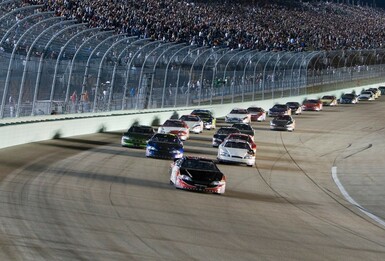
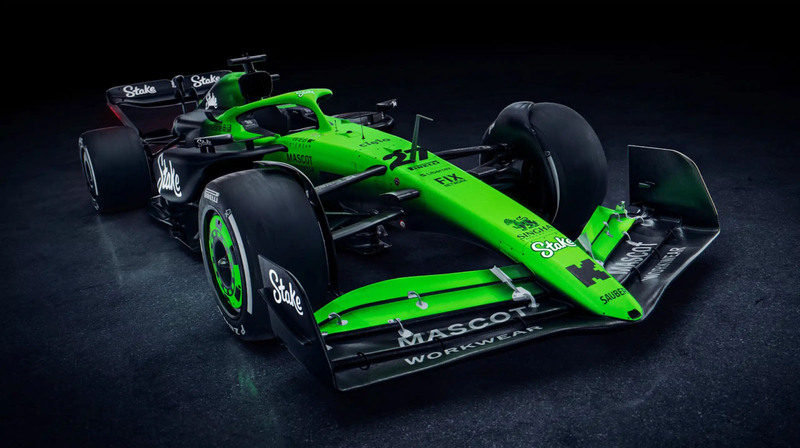
Formula 1 racing is undoubtedly the fastest sport in the world. Sure, NASCAR and IndyCar drivers hit some truly impressive top speeds, but neither sport has the combination of pure top speed and cornering speed that F1 does.
So, how fast do F1 cars go, and what goes into making their mind-boggling top speeds possible? Here’s everything you need to know to understand what makes F1 cars so special, including the incredible amount of fine engineering that goes into getting each vehicle on the track on race weekend.
Don’t forget: You can catch all your favorite F1 drivers, like Max Verstappen, George Russell Lewis Hamilton and Charles Leclerc tearing up the racetrack during the 2026 F1 season on DIRECTV!
How Fast Do F1 Cars Go?
Anyone who’s ever watched an F1 race can confirm: F1 cars are really, really fast. At times, it almost looks like they’re floating, rather than rolling, around the track.
Speed is the number one metric most people pay attention to when watching F1. The top average speed of an F1 car is around 210 to 220 miles per hour (337.9 to 354 kilometers per hour).
The fastest speed ever recorded for an F1 car during a race was 234 miles per hour, recorded by Valtteri Bottas (currently driving for Cadillac) at the 2016 European Grand Prix. Honda set the overall speed record for an F1 car at 245 miles per hour during a test at the United States’ Bonneville Salt Flats.
F1 Car Speed vs. NASCAR & IndyCar Speeds
F1 is a global racing sensation, but IndyCar and NASCAR, two American racing sports, are also wildly popular and boast vehicles with some impressive top speeds.
Technically, IndyCars, with a top speed of around 236 miles per hour, are slightly faster than Formula 1 cars. IndyCar courses tend to have more straightaways and are more commonly oval-shaped. It takes IndyCars longer to reach their top speeds than an F1 car, which can go from 0-60 in just 2.6 seconds.
NASCAR speeds top out at about 199 miles per hour, making NASCAR cars slower than both F1 and IndyCar cars. NASCAR top speeds are regulated by the sport’s governing body restricting speed after some high-profile incidents that injured drivers and, occasionally, spectators. NASCAR’s vehicles are generally heavier than F1 cars or IndyCars. The typical NASCAR car’s zero-to-sixty is about 3.4 seconds, far longer than the F1 or IndyCar.
How Do F1 Cars Work in 2026?
What does it take to push a car to such whiplash-inducing speeds and ensure drivers can rack up those all-important F1 points and earn their hefty salaries? A lot of very complex engineering and cutting-edge technology.
These are some of the fastest, most technologically advanced vehicles on the planet, and it takes some serious science to get them running and keep them running.
In 2026, Formula 1 underwent a massive, historic rules change that overhauled the regulations F1 cars must operate under. These changes have proved semi-controversial so far, with top drivers like Max Verstappen of Red Bull complaining that they are overly complex and are “anti-racing” in spirit, while other drivers like Ferrari’s Lewis Hamilton, currently the best-ever driver in F1 history, have said they are enjoying the new way the cars handle and having more fun racing under the new rules.
Ahead of the 2026 Japanese Grand Prix, F1 and the FIA, the sport’s governing body, loosened some of the rules to allow higher speeds on qualifying laps.
How Do Aerodynamics Affect F1 Cars?
The physics involved in making sure an F1 car can cut through the resistance the air puts on it and giving the driver the ability to change the vehicle’s configuration at will to take advantage of those physics is one of a constructor’s chief concerns when designing an F1 car.
In F1, engineers have two goals related to aerodynamics: generating downforce and minimizing drag.
Downforce is the downward pressure the car’s components, like its wings and the chassis, exert on the vehicle, pressing it into the road’s surface and increasing its grip, handling and cornering speed.
Drag is the resistance the car meets from the air as it moves forward.
Greater downforce and less drag equals a faster car with better handling, two things critical to winning an F1 race. Each F1 car is equipped with numerous aerodynamic components that work towards achieving this goal.
How Do F1 Car Engines Work in 2026?
F1 cars have special hybrid engines that uses both combustion and electrical energy propel the vehicle. New to the 2026 season, F1 car engines are now required to get at least half of the energy they use from electricity.
These include:
- The combustion engine: F1 cars have internal combustion engines similar to those powering most consumer vehicles, but these advanced engines are turbocharged and pushed to their absolute limits.
- Battery: F1 cars have onboard batteries that power the engine and collect energy to use for speed boosts throughout the race.
- The Energy Recovery System (ERS): F1 cars are equipped with an energy recovery system that includes a Motor Generator Unit Kinetic, or MGU-K, that harvests electrical energy from the car when it is braking. The energy collected by an F1 car’s MGU-K can be used to provide brief speed boosts at various points in the race.
How Does Active Aerodynamics Work in F1 in 2026?
In the 2026 season, drivers now have access to a new system for getting boosts of speed during a race called Active Aerodynamics. “Active Aero,” as it’s known, replaced the Drag Reduction System, or DRS, that was used in previous seasons.
Active aero has two modes: straight mode and cornering mode. Straight mode in F1 active aerodynamics reduce the angle of the wings to allow for higher speeds on straights, while the cornering mode adjusts the wings to increase the angle and generate more downforce during turns for better grip.
One of the biggest changes with active aerodynamics is that it allows the front wings to move. Under the drag reduction system, only the rear wing could be opened and closed, and doing so was only allowed when a driver was within one second of the car in front of them to assist in overtaking. Active aerodynamics can be used at any point during the race, by any driver.
F1 cars in 2026 have flat floors again, removing the Venturi tunnels that would allow air to flow underneath the car and help suck it down towards the road surface, increasing downforce.
F1 Car Tires, Explained
F1 tires rely on advanced tire technology, and they’re pretty strange looking compared to the tires you might be used to on a typical car. Some have an almost balloon-like appearance with almost no tread at all, opting instead to use stickier compounds to improve grip. Plus, they’re engineered to withstand the high temperatures that come with higher speeds.
Formula 1 cars use three types of tires: slicks, intermediates and wet weather tires. Slick tires in F1 come in five types, with type 1 (C1) being the hardest and type 5 (C5) being the softest. You can tell which type of tire a driver is currently using in an F1 race either by looking at the colored lines on the side of the tire or at the race leaderboard display if you’re watching on TV.
Softer slick tires are marked red for the softest, yellow for the middle option and white for the hard version. The softer a slick tire is in F1, the more grip and speed it provides, but they need to be changed more frequently. Intermediates and full wet tires in F1 are used during inclement weather like rainstorms.
Drivers are required to use at least two types of slick tires during a single F1 race as long as the track is dry enough. Each driver is allowed 13 sets of slicks, five sets of intermediates and two sets of full wets per Grand Prix race. During shorter F1 Sprint races, drivers get 12 sets of slick tires, six sets of intermediate tires and two sets of wet tires.
Real-Time Telemetry in Formula 1
F1 teams have incredible amounts of data being fed back in real-time from their cars at their fingertips during races. This includes the engine and tire temperatures, brake pressures, fuel efficiency and other metrics, which allows them to make adjustments on the fly and get ahead of any potential part failures that could cost them time — or worse — on race day.
The rich telemetry data coming off of the cars can also help teams re-strategize during the race to give their drivers a better shot at winning.
F1 Car Steering Wheels
The wheel of an F1 car is complex and covered in numerous buttons and indicators. F1 steering wheels are designed to give drivers precise control over their vehicle’s performance during a race and lets their team relay crucial information from all of telemetry data they’re receiving.
How Much Does an F1 Car Cost in 2026?
An F1 car currently costs between $12 million to $20 million to field in a race. Most of the cost of an F1 car is associated with the engine and power unit.
F1 enforces a cost cap, designed to ensure each team has a fair shot at winning no matter how much money they’re able to spend. The F1 cost cap is currently set at $215 million in 2026, and it covers all of the materials and activities related to maintaining the car’s performance — the parts, mechanics and other inputs.
Tires cost about $2,700 per set of four. An F1 team typically burns through about a dozen sets between their two drivers each race for a total tire cost of about $35,000 per event.
Watch F1 on DIRECTV in 2026
You can catch all of the action during F1’s 2026 season of racing right on DIRECTV! Don’t have DIRECTV yet? Sign up now!
Trouble keeping track of who F1 drivers like Liam Lawson, Yuki Tsunoda and Lando Norris are driving for? Don’t forget to check out the 2026 season driver line-ups.

Frequently asked questions
How fast do F1 cars go?
F1 cars can reach top speeds of 210-220 mile per hour.
How much does an F1 car cost to build?
F1 cars can cost between $12 million and $20 million to build.
DIRECTV Insider brings you our views on what’s happening in streaming, t.v., movies and sports. Companies and persons mentioned are not necessarily associated with and do not necessarily endorse DIRECTV. We will disclose sponsored content on our site when we show it to you, and some of the links on the site may be ads or affiliate links which means DIRECTV may earn compensation from your purchases.