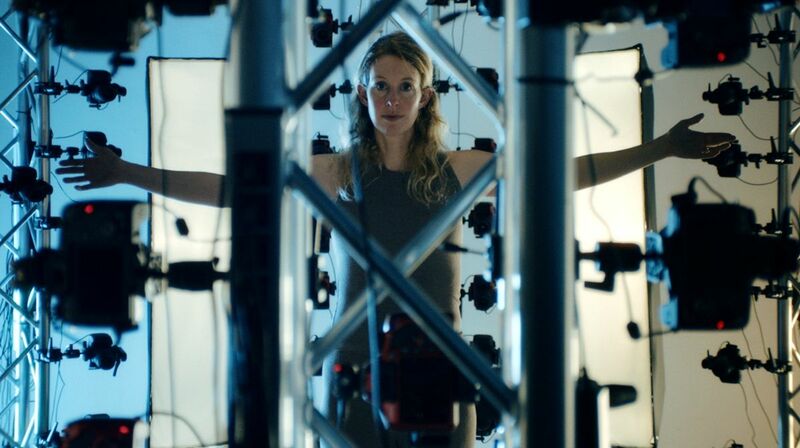
Elizabeth Holmes has been the subject of countless headlines, investigations and dramatizations, but you’ve never seen her story told quite like this. In You Can See Everything, filmmakers Nathan Fielder and Lance Oppenheim take an unconventional approach to the disgraced Theranos founder, delivering a documentary that’s as bizarre and uncomfortable as it is fascinating.
The latest film from A24, You Can See Everything premiered in theaters on October 16, 2026.
If the film left you questioning what’s real, who’s telling the truth or how much a camera can actually reveal, there are plenty of other documentaries worth exploring. From elaborate deceptions and corporate scandals to experimental filmmaking that blurs the line between fact and fiction, here are 10 documentaries to watch after You Can See Everything.
From thrillers and award-winning dramas to documentaries that make you question everything you know, A24 has an extensive repertoire of films. Watch more A24 films with DIRECTV!
What Is ‘You Can See Everything’ About?
In 2023, just 34 days before beginning her prison sentence, Elizabeth Holmes invites a documentary crew into her home to capture her final weeks of freedom. The former Theranos CEO, convicted of defrauding investors after her revolutionary blood-testing technology failed to live up to its promises, hopes to tell her side of the story alongside her partner, Billy Evans.
Behind the camera are Nathan Fielder, a comedian best known for Nathan for You and The Rehearsal, and Lance Oppenheim, director of Some Kind of Heaven and Primetime. Fielder brings his signature deadpan humor, along with his tendency for awkward, uncomfortable questioning, while Oppenheim contributes his distinctive, highly stylized approach to documentary filmmaking.
What begins as an intimate portrait of Holmes becomes something far less conventional. Over the course of three years, the filmmakers explore questions of deception, authenticity and how people attempt to control their public image. Rather than simply revisit the Theranos scandal, You Can See Everything challenges viewers to consider how much they can really trust what they’re watching.
The nearly three-hour A24 documentary premiered in theaters on October 16, 2026. Here’s a first look:
Best Documentaries to Watch After ‘You Can See Everything’
Whether you were drawn in by the white-collar crime, Fielder’s interview style or the film’s unconventional storytelling, these 10 documentaries offer something to keep you questioning what you see on screen:
1. ‘The Inventor: Out for Blood in Silicon Valley’ (2019)
Director: Alex Gibney
Available on: HBO Max
Subject: Elizabeth Holmes’ fraudulent scandal
For those interested in the rise and fall of Elizabeth Holmes, The Inventor: Out for Blood in Silicon Valley offers a more traditional investigation into the Theranos scandal. Directed by Alex Gibney, the documentary traces how Holmes went from a Stanford dropout with an ambitious vision for revolutionizing blood testing to the face of a multibillion-dollar company built on technology and fraudulent claims.
Through interviews with former employees, whistleblowers and journalists, the film examines how Holmes convinced powerful investors and influential figures to believe in her vision, even as evidence of the company’s failures continued to emerge. While You Can See Everything offers a look at Holmes after her conviction, The Inventor explores how she cultivated her carefully constructed public image in the first place, and why so many people were willing to believe it.
2. ‘The Amazing Johnathan Documentary’ (2019)
Director: Benjamin Berman
Available on: Hulu
Subject: Comedian and magician, The Amazing Johnathan
When comedian and magician John Edward Szeles, better known as The Amazing Johnathan, announces that he’s dying from a terminal heart condition, filmmaker Benjamin Berman sets out to document his final days. But what begins as a straightforward portrait of the eccentric performer quickly takes a bizarre turn as Berman starts questioning whether his subject is telling the truth, or simply pulling off another elaborate trick.
As increasingly strange revelations complicate the production, Berman finds himself sucked into the documentary’s unfolding web of drama, struggling to distinguish genuine moments from carefully orchestrated performances. The result is a darkly funny and unpredictable film in which the filmmaker becomes just as much a part of the story as his subject. With a professional liar and trickster at its center, The Amazing Johnathan Documentary raises an intriguing question: How can you trust someone whose entire career has been built around fooling people?
3. ‘Louis Theroux: Inside the Manosphere’ (2026)
Director: Adrian Choa
Available on: Netflix
Subject: Theroux’s investigation into manosphere influencers
British documentarian Louis Theroux ventures into the controversial world of the manosphere, meeting the influencers who have built massive online followings by promoting hypermasculinity, traditional gender roles and often deeply misogynistic views. Among them is Harrison Sullivan, better known as HSTikkyTokky, whose provocative online persona and confrontational behavior become a central focus of the documentary.
Theroux has spent decades perfecting the art of making people uncomfortable without appearing particularly confrontational himself. Much like Nathan Fielder, he relies on an unassuming demeanor, deceptively simple questions and prolonged awkward silences that encourage his subjects to reveal more than they might intend. As Theroux spends time with these influencers, the disconnect between their carefully cultivated online personas and their real-life behavior becomes increasingly apparent. Absurdly funny at times, deeply disturbing at others, the documentary demonstrates just how revealing an uncomfortable conversation can be.
4. ‘The Imposter’ (2012)
Director: Bart Layton
Available on: Prime Video
Subject: Frédéric Bourdin and the disappearance of Nicholas Barclay
In 1994, 13-year-old Nicholas Barclay disappeared from his hometown of San Antonio, Texas, leaving his family desperate and searching for answers. Three years later, a young man claiming to be Nicholas resurfaces in Spain, and his family welcomes him home. There’s just one problem: He’s actually Frédéric Bourdin, a 23-year-old French con artist who looks absolutely nothing like the missing teenager. Despite glaring differences in his appearance, mannerisms and even his accent, Bourdin manages to convince Nicholas’ family that he’s their long-lost son.
Director Bart Layton combines interviews with cinematic reenactments to reconstruct the extraordinary deception, allowing Bourdin himself to recount how he pulled it off. But as the story unfolds, questions start to pop up about how much the family knew and why they were so willing to believe him. With its unreliable narrator and carefully constructed scenes, The Imposter challenges viewers to question not only the people telling the story, but also how the documentary chooses to present it.
5. ‘Spermworld’ (2024)
Director: Lance Oppenheim
Available on: Hulu
Subject: Online sperm donors
In Spermworld, director Lance Oppenheim explores the bizarre world of online sperm donation, where men offer their services to strangers looking to conceive outside traditional fertility clinics. The documentary follows several donors and prospective parents navigating this largely unregulated community, where arrangements are made through Facebook groups and private messages, and methods of insemination range from the classic turkey baster to intercourse. What you might not expect, however, is the surprisingly intimate portrait of people driven by everything from a desire to help others start families to their own complicated needs for connection and purpose.
Oppenheim, who also co-wrote and co-directed You Can See Everything, brings his distinctive visual style to the film, using carefully composed shots and a dreamlike atmosphere to make ordinary interactions feel strangely theatrical. Yet beneath the documentary’s more absurd and uncomfortable moments are genuine questions about loneliness, intimacy and the lengths people will go to fulfill their personal desires. It’s a great example of how real life can be considerably stranger than anything a filmmaker could think up.
6. ‘The Armstrong Lie’ (2013)
Director: Alex Gibney
Available on: Prime Video
Subject: Lance Armstrong and his doping scandal
When filmmaker Alex Gibney began documenting Lance Armstrong’s return to professional cycling in 2009, he intended to tell the story of a celebrated athlete attempting one last comeback. But as allegations of performance-enhancing drug use caught up with the seven-time Tour de France winner, the project pivoted. What was supposed to be a triumphant comeback story became an investigation into one of the biggest scandals in sports history.
Rather than abandon the project, Gibney revisits his original footage and confronts Armstrong about the elaborate deception that helped maintain his reputation. The Armstrong Lie is really as much about the filmmaker’s relationship with his subject as the scandal itself, examining how Armstrong manipulated the media, including Gibney himself, and maintained his carefully constructed public image for years.
7. ‘Casting JonBenet’ (2017)
Director: Kitty Green
Available on: Netflix
Subject: The JonBenét Ramsey murder case and public perceptions of it
In 1996, six-year-old beauty pageant contestant JonBenét Ramsey was found murdered in her family’s Colorado home, sparking one of the most widely publicized unsolved cases in American history. Rather than revisit the evidence or attempt to identify her killer, director Kitty Green takes an unconventional approach in Casting JonBenet, inviting local actors to audition for roles portraying JonBenét, her family members and others connected to the case.
As the actors prepare for their auditions, they share their own theories about what happened and personal experiences that shape their perspectives, revealing just how deeply the case has embedded itself in the public imagination. Green blends these interviews with staged performances, creating a documentary that explores how speculation, memory and personal experiences influence the way people understand a case that has captivated the public for decades. As a result, the documentary illustrates how people construct their own versions of the truth, and how easily the line between speculation and fact can become blurred.
8. ‘Enron: The Smartest Guys in the Room’ (2005)
Director: Alex Gibney
Available on: Prime Video
Subject: The Enron corporate fraud scandal
Before Theranos became synonymous with corporate fraud, there was Enron. Once celebrated as one of America’s most innovative companies, the energy giant collapsed in 2001 after years of accounting fraud, hidden debt and financial manipulation came to light. Directed by Alex Gibney, Enron: The Smartest Guys in the Room examines how executives Kenneth Lay, Jeffrey Skilling and Andrew Fastow helped orchestrate a massive deception that cost investors billions and left thousands of employees without their jobs or retirement savings.
Through interviews, recordings and archival footage, Gibney exposes the arrogance and corporate culture that allowed the fraud to continue unnoticed. Like Elizabeth Holmes, Enron’s leadership cultivated an image of groundbreaking innovation while concealing the company’s increasingly precarious reality. For viewers particularly fascinated by the white-collar crime aspect of You Can See Everything, the documentary offers another astonishing example of how charisma, ambition and false promises can help powerful people get away with extraordinary levels of deception.
9. ‘The Act of Killing’ (2012)
Directors: Joshua Oppenheimer, Christine Cynn, Anonymous
Available on: Prime Video
Subject: Perpetrators of the Indonesian mass killings of 1965–66
In one of the most unsettling documentaries ever made, filmmaker Joshua Oppenheimer confronts former Indonesian death squad leaders responsible for participating in the mass killings of suspected communists during the 1960s. Rather than simply interview the perpetrators about their crimes, Oppenheimer invites them to reenact the murders in whatever cinematic styles they choose, from gangster movies to elaborate musical numbers. The result is The Act of Killing, a documentary in which men responsible for horrific atrocities enthusiastically recreate their own acts of violence.
What makes the film so disturbing is how openly its subjects discuss their crimes, seemingly unconcerned with how they’ll be perceived. As the reenactments grow increasingly elaborate, the documentary exposes the stories these men have told themselves to justify their actions and maintain their status as celebrated figures in their communities. It’s a deeply uncomfortable examination of how people rationalize horrific acts and the lengths they’ll go to avoid taking responsibility.
10. ‘F for Fake’ (1973)
Director: Orson Welles
Available on: HBO Max
Subject: Art forgery, literary hoaxes and the nature of deception
Legendary filmmaker Orson Welles takes audiences on a wild ride through the art of deception in F for Fake, an experimental documentary that explores the stories of notorious art forger Elmyr de Hory and his biographer, Clifford Irving, who became infamous for fabricating an autobiography of billionaire Howard Hughes. But in classic Welles fashion, he isn’t content with simply recounting their elaborate schemes. Instead, he inserts himself into the film as a magician and storyteller, using editing, staged sequences and deliberate misdirection to play tricks on the audience.
Part documentary, part elaborate magic act, F for Fake challenges viewers over and over again to distinguish fact from fiction, often revealing that they’ve been fooled only after the fact. Welles delivers a clever lesson in how readily audiences accept the information presented to them at face value, pushing viewers to reflect on how they can better question and challenge what they’re being told. Decades before Nathan Fielder began experimenting with the boundaries of documentary filmmaking, Welles was already challenging audiences to think critically about the media they consume and how easily their perceptions can be manipulated.
Watch More Documentaries With DIRECTV
Documentaries teach us about the world and people around us, our history and even ourselves. They can bring us into the lives of the world’s most powerful people or take us to the most remote corners of the planet. They teach us things we never knew and challenge what we thought we understood.
Whether you’re looking for more white-collar crime documentaries or something completely different, DIRECTV has plenty to keep you entertained.
Watch more documentaries with DIRECTV. Don’t have DIRECTV yet? Sign up today!

Frequently asked questions
Is 'You Can See Everything' a true story?
What other documentaries are about Elizabeth Holmes?
DIRECTV Insider brings you our views on what’s happening in streaming, t.v., movies and sports. Companies and persons mentioned are not necessarily associated with and do not necessarily endorse DIRECTV. We will disclose sponsored content on our site when we show it to you, and some of the links on the site may be ads or affiliate links which means DIRECTV may earn compensation from your purchases.